Category Archives: Fleets

PRSA Fleets

2025-26 PRSA Laser Frostbite #7

Hi everyone,
Greetings from 1st place – we’re switching up the write-up person this week. I owe Farley a write-up, and even though Farley didn’t sail, I’m still happy to do it this round.
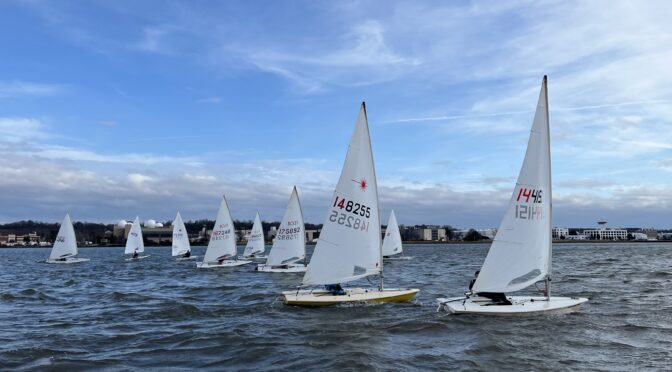
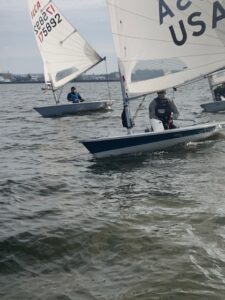
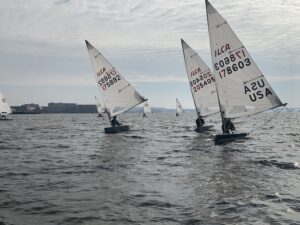
It was a great day! Sunny, not too cold, lots of boats on the water – and my absolute favorite conditions: super puffy and shifty. Thanks to Steen and Cuong for supporting us through five very solid races in spite of the variable conditions.
I’m going to focus on two main themes. First up: Navigating puffy/shifty.
I think I love puffy/shifty because it is inherently interesting, requires extra focus, and means super dynamic racing with greater potential to both lose and gain spots. Here is what worked for me:
  • It was critical to stay on the lifted tack, even if it meant losing a bit by staying in bad air or fighting to keep a lane (especially after the start). The alternative was to very likely lose not just a few boat lengths but dozens or more in a relatively short period of time by being on the headed tack, even briefly.
    • Related: it was critical to be ready to tack at a moment’s notice to stay on the lifted tack.
    • Also: sometimes the wind would decrease significantly, but not really shift very much. I resisted the urge to tack immediately during sudden lulls and waited a beat to see whether the change was indeed a header or just a shift in apparent wind that made it seem like a header.
  • I spent a LOT of time with my head out of the boat, especially looking upwind for puffs. While sailing upwind, I kept an eye out to be ready for a big ease/hike and to adjust my heading when the puff came; downwind, I wanted to make sure I was ready to add extra vang and bring in my sail a bit to better handle a strong gust and ultimately avoid flipping. It was also helpful to see where other boats were and how they were heading – for example, so I could better anticipate how the next shift would affect me.
  • I stayed mindful of shifting gears – especially for me, this meant releasing the cunningham during extended lulls.
In other words, these conditions were all about anticipation, focus, and being ready to take action (e.g., tack) at any time.
Second theme: the mental game.
To me, we spend most of our time talking about two main categories for improvement: setting controls/general boat handling and tactics/strategy, both of which are important. But I think the mental game is also super critical, and we tend to neglect discussion of it. One key observation from today:
  • Arrive with an intentional mindset. I didn’t have the best day during the Hangover Bowl, and I think it was partly b/c I felt overpowered and frustrated that I couldn’t adjust my controls very well due to the ice. But I also didn’t come with the right mindset, and it showed. Maybe in part due to this, I came to racing Sunday intentionally with more of a “I’m going to give this day everything I’ve got – and I’m going to fight for every boat/place” mentality — but also held lightly, in an experimental, “let’s try this and see” way —  and I think it really helped. I’m one of those people who just loves being on the water, and if I’m not feeling extra competitive, I still have fun – but I also like to do well. Today was a big reminder for me about the stories we tell ourselves and how shifting a mindset (or belief about ourselves) can make a big difference.
Here’s hoping that this milder weather continues. See many of you on Sunday!
Laura
Scores:

25-26 PRSA FROSTBITE #6

A great winter day of sailing: steady, consistent wind from the south; cold but not freezing; and gray! Tom and Mike ran 5 Windward/Leeward races, with a relatively square line. We were joined by three sailors from other clubs, which made for a strong fleet. I’ve been slowly but steadily moving up the fleet this year, thanks in good measure to the two sailors – James and Steen who offer sage advice is you listen carefully.  So, here’s my secret to improvement:

1) Imitation – If you can’t beat them, copy them! While still slower, I used either James or Steen as a test boat, with the goal to try to lose less distance than I usually do. I’ve given up on playing with the outhaul but work the downhaul and vang much more aggressively.
2) Be on the line and in a good place to get clean air.  If you don’t have a good start, it’s nearly impossible to make up that many boat lengths when sailing in bad air. I ended up tacking quickly to port on a few races to find good air.
3) Ignore your windward telltale – learned this from the clinic a few weeks ago with James. Makes a huge difference.
4) Do not let a gust go to waste – I’ve leaned hard into the keep-the boat-flat-school of sailing! I played the mainsheet more aggressively to keep the boat flat, even in gusts.
5) Don’t make dumb mistakes – suffice it to say, hitting the mark, not seeing a boat on starboard, getting a line tangled in your leg all slow you down!
-Brian Joseph


25-26 PRSA Laser Frostbite #4

Thanks to Jim and Dan for putting on a great day of racing. I had pretty low expectations driving to the marina, but the breeze ended up being way better than expected. Checked SailFlow afterward and it showed a pretty consistent 8 knots out of the south. I didn’t notice any major shifts, so with the short 15-minute races there really weren’t gains to be made playing the shifts.

My plan for the day was simple: start at the boat, which seemed consistently favored, and prioritize clear air above everything else. If I wasn’t bow-out on the boats around me, I tacked out immediately. I’ve noticed a lot of sailors sit in bad air far too long. To me, clean air is the most important thing.

One thing that hurt me more than once was not being fully prepared before the windward mark. I’ve gotten better at blowing my vannd cunningham before the three-boat circle, but I lost boats/positions on at least two roundings because my mainsheet didn’t run free because of tangles or wraps around my ankles. Lesson learned: get the boat sorted before you round.

Downwind, I sailed inside as much as possible. After the clinic Steen and James put on, I added a mark on my mainsheet for when the boom is perpendicular to the boat. Dead downwind or by the lee, I set the boom to that mark or about three feet farther out. For the first time, I felt like I had decent downwind boat speed.

The leeward mark was absolutely the critical moment each race. Coming in from the inside on starboard, the key was to make a clean, tactical rounding that either matched or improved on the boat in front. With the boat end favored, the only play was to sail all the way to layline and then tack. Tacking early basically guaranteed you wouldn’t catch the boat ahead since it forced an extra tack (I tried and it hurt). I also noticed many people rounding too tight and then sailing too low and too slow afterward. Sailing just a touch wide and rolling into a clean, powered-up exit made a noticeable difference. I also threw my vang handle over the port gunwale before the rounding so that after the gybe it was already positioned for a quick adjustment.

All in all, a great day on the water!

-Tyler


25-26 PRSA LASER FROSTBITE #4

25-26 PRSA LASER FROSTBITE #3

Happy late Thanksgiving everyone!! It was wonderful to have our first foul weather frostbite of the year. Ten sailors braved ~40-degree weather, off-and-on rain, and 10-20 mph wind. Congrats to Kaitlyn, Tom, and Tyler for winning today’s six races.

Today’s courses tended to have long starboard tacks, which was unfortunate for me – I accidentally brought two left gloves out with me and had to spend several minutes fighting to keep my mainsail sheeted in with a backwards glove on my right hand. This also meant that most of the passes took place at the marks, so boathandling during roundings was at a premium. In medium-heavy air, it’s crucial to ease the vang on approach to the windward mark and use your body weight to turn the boat. These actions relieve weather helm and help turn the boat more efficiently. Tom and Tyler seemed to a particularly good job of cleanly rounding the weather mark and getting a good jump on the downwinds. At the leeward mark, it was important to preset your controls for the upwind and doing a wide and tight rounding. I passed more than a few people today by making sure I was on the correct (port) gybe approaching the mark and going wide-and-tight around the mark to make sure I got inside position. Every time I messed this up, I got passed.

After the races, I had a brief conversation with Tyler about heavy wind downwinds. The first thing I told him is that I prefer to reach, rather than sail by the lee in breeze over 12 mph. It helps keep the boat upright, makes pumping and planing easier, and allows for more maneuverability on short notice. We also discussed body position in the cockpit. As a rule of thumb, you want to be at the front of the cockpit in a Laser any time the hull is not planing. On lighter downwinds, I try to have by center of mass even with the daggerboard. Having weight further forward in the boat lifts the largest surface on your hull (the stern) out of the water to reduce drag. In heavier breeze, I try to move back to the widest part of the hull to use my weight to more effectively prevent death rolls.

Thanks to Brian Joseph and his daughter for setting excellent courses and taking care of us on the water. They did an excellent job of setting up pin-favored lines, which made for more tactically interesting starts and fewer clumps at the boat end of the line. See y’all next week.

-Connor

25-26 PRSA FROSTBITE #2 REWORKED

25-26 ILCA Frostbite #2

Welcome back to everyone who made it out Sunday!  There was some mix up on who got 3rd place today so I have the writeup from 2nd place and Laura will owe me a writeup later!  We had a good turnout with 19 boats coming out and moderate breeze and temps around 60.  Thank you to Jacob and Tyler for doing RC and getting 5 races off despite a late start and wind shift!  Kudos to Brian for getting 3 bullets, who said he learned some things at the clinic 2 weeks ago!  Also congrats to Kaitlyn on getting a bullet in race #4.
I have not sailed since the last frostbite series and was quite worried about the rust and being out of shape but I guess I was proven wrong.  Some thoughts on today.
In the first 3 races we had a nice southerly breeze that had some velocity changes but did require some hiking.  With the conditions of the day and sailing on that part of the river I have found that during a southerly with an outgoing tide you almost always are faster going downwind closer to the DC side of the river.  This is counter intuitive as you give up being the inside boat but something about the geography of the river makes this work.  I did that in all 3 races and it paid off (my starts were not great).  For starts, the wind and current were about even so it was fairly early to set up and wait at the line.  I did not do this well but did notice it.
Near the end of race 3 our westerly finally came so we reset the course.  The last two races were much tougher.  We had a short start line with a current running down it so there was often a pile up at the pin.  I tried to avoid that and started near the boat mostly.  With a westerly breeze it is always a bit squirrely at the windward mark and today did not disappoint.  Mostly just be ready for anything and lots of place changes.  For our races today mostly the pressure shots were coming from the left so it paid off to be further left.  The port tack tended to be lifted so you wanted to ride that as long as possible.  Also in the shifty conditions, make sure you are looking at boats ahead of you to know what is coming!
Great day out on the water and hope to see everyone out again soon!

2025 June 1 Spring Series

Nelson Pemberton and team ran the races.  Barney Harris was running the mark boat.  It was day 2 of the Lightning Doc Gilbert Potomac Cup.

The winds were from the west and shots of breeze were coming in from both the left and right.  At one point the wind went way right but by the end of the day it had shifted way left.

The Lightning class saw a very skewed start line that was difficult to lay on starboard.  That created a mix of strategies from trying to start on port, coming down the line on starboard but tacking to port before the gun, to dip starts.  Chaos ensued at the pin.

SS8-Albacore

SS8-I20

SS8-Laser

Doc Gilbert Potomac Cup Results

2024-2025 ILCA Frostbite #16

Sunday was an awesome day for sailing! Huge thanks to the RC for putting on six fantastic races. The breeze was shifty, ranging from 10-17 knots, with a few gusts creeping into the low 20s—right on the edge of my threshold for switching to the radial. At 15+ knots, I feel like I gain more by keeping the boat flat and pointing higher with the radial than I lose in sail area.

Starts:

The boat end was favored, and at times, it almost felt like you could lay the mark straight from the boat. (Well, except for that one start where tacking immediately was the only way to cross the starting line!) My plan was to start near the boat but not necessarily fight to win it, and I noticed many others had the same idea.

One thing that stood out was late acceleration. A lot of boats were setting up too close to the line without putting their bow down early enough. If you don’t accelerate in those last few seconds, it doesn’t matter how good your position is—you’ll just get rolled. Hitting full speed at the gun is something I’ve been working on this season, and it definitely makes a difference in these short races.

First Beat:

With shifty conditions, I noticed a lot of sailors staying on the headed tack longer than they should. I often found myself pinned by boats that weren’t tacking on the shifts. To stay flexible, I tried to work the middle of the course, looking for opportunities to take advantage of the shifts.

Downwind:

I’ll be the first to admit—I’m not the fastest downwind. Rounding the windward mark a couple of boat lengths behind Steen, I’d watch him pull ahead by 8+ lengths by the time we were ¾ of the way down. But hey, I stayed upright, which is definitely faster than the alternative!

One thing that helped me stay in control was my vang setup. My boat is rigged so there’s just enough play in the vang to clip it to the boom, sometimes I even need to hold the boom down to clip it in. The setup limits how high the boom can rise when the vang is fully eased. The boats that seemed out of control downwind had a lot more vang play, which was obvious from how high/twisted their booms were. I think the solution is both to sail with more vang on and to limit how much vang can be eased. I still blow the vang before the windward mark and then put a bit back on to maintain control downwind.

Leeward Mark & Second Beat:

I focused on tight mark roundings, slowing down when I was the outside boat if necessary to sail wide and tight. I didn’t see much advantage in staying on port, so I almost always tacked as soon as I could (though I mistimed one and ended up in irons at the mark—lesson learned!).

For the second beat, I tried to stay on starboard as long as possible, waiting for the shifts to sail the lifted tack up to the mark. I wasn’t pinned by other boats, as those I rounded the mark with tended to stay on port. That gave me the freedom to tack and focus on easing, hiking, and trimming my way to the mark while keeping the boat flat, which was not easy in some of the bigger gusts.


All in all, a great day on the water! Looking forward to the next one.

Tyler

24-25 Laser Frostbite Series #16