Category Archives: Regattas

2023 Hangover Regatta

Sunday was a refreshing day after such a chilly Christmas weekend The sun was shining, the temperatures were hovering on either side of 60 degrees, and the A-team was running races. The only problem was the wind never freshened beyond 4 or 5 mph.Nonetheless, we had four fun races.

Thinking about the race course a couple of variables came to mind. First, the wind was oscillating about 15 degrees either side of 180( 30 degrees total).Second, the flood was hard, so that meant that the middle and right had far less current.Third, the course seemed port biased. Finally, the line varied between pin favored to extremely pin favored. When weighing these variables I felt that a pin vicinity start( not necessarily winning the pin) was critical. Every race there seemed to be a left hand shift reasonably soon after the start. This allowed a quick tack to port with an easy long tack to the top of the course. I pretty much dismissed the stronger current given the combination of pin end bias and weather mark bias. Downwind, I felt that looking for wind lines was paramount. For the most part I stayed to the right( looking downwind) of the rhumbline given the current as long as wind was present. I made my mark-room moves only at the bottom of the course. The second weather leg offered a bit more to think about. In race one for instance there was an extreme left hand phase until we passed the airport landing pier. At that point Alex and I traded tacks along the jet blasts all the way to the weather mark. In races two through four the breeze seemed best in the middle of the course on that leg.On those legs I just attempted to stay in phase with the shift pattern noted above.
Boat speed, boat handling, set up, etc: There are countless pieces written on this website, SSA Fleet 10s’ Cedar Point’s, Newport’s and many others, some even written by me. Therefore I won’t bore you with detail. Here are some observations of some mistakes I saw: 1.Boats were too heeled. Heeling the boat creates rudder drag.  2. If your vang was loose upwind you were slow. The draft needs to be between 1/3-1/2 way back. The vang achieves this. 3. If you trimmed your cunningham one time Sunday, you lost boats. The leech is too loose and the sail entry too fine with a tight cunningham in a drifter. 4. Outhauls were almost all too tight.
In sum, I thought the key on Sunday was to prioritize the variables based upon each one’s risk and reward and to make sure that the boat had as much power as possible to keep moving in the light conditions. We all owe huge thanks to Len, Barbara, Tom, and Kevin, the RC team, who sacrificed their sailing day to make the racing possible. I also want to thank Alex and Jake for driving from NYCC to spice things up, and for Mike for coming from SSA.
Happy New Year!
James Jacob
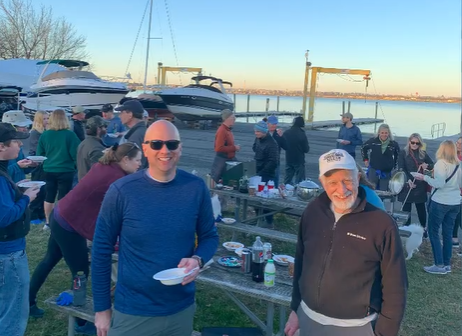
Additionally: Thanks to everyone that brought delicious food to potluck.  Particularly the sailor’s wives that cooked while we were out sailing!

2016 Hangover Regatta

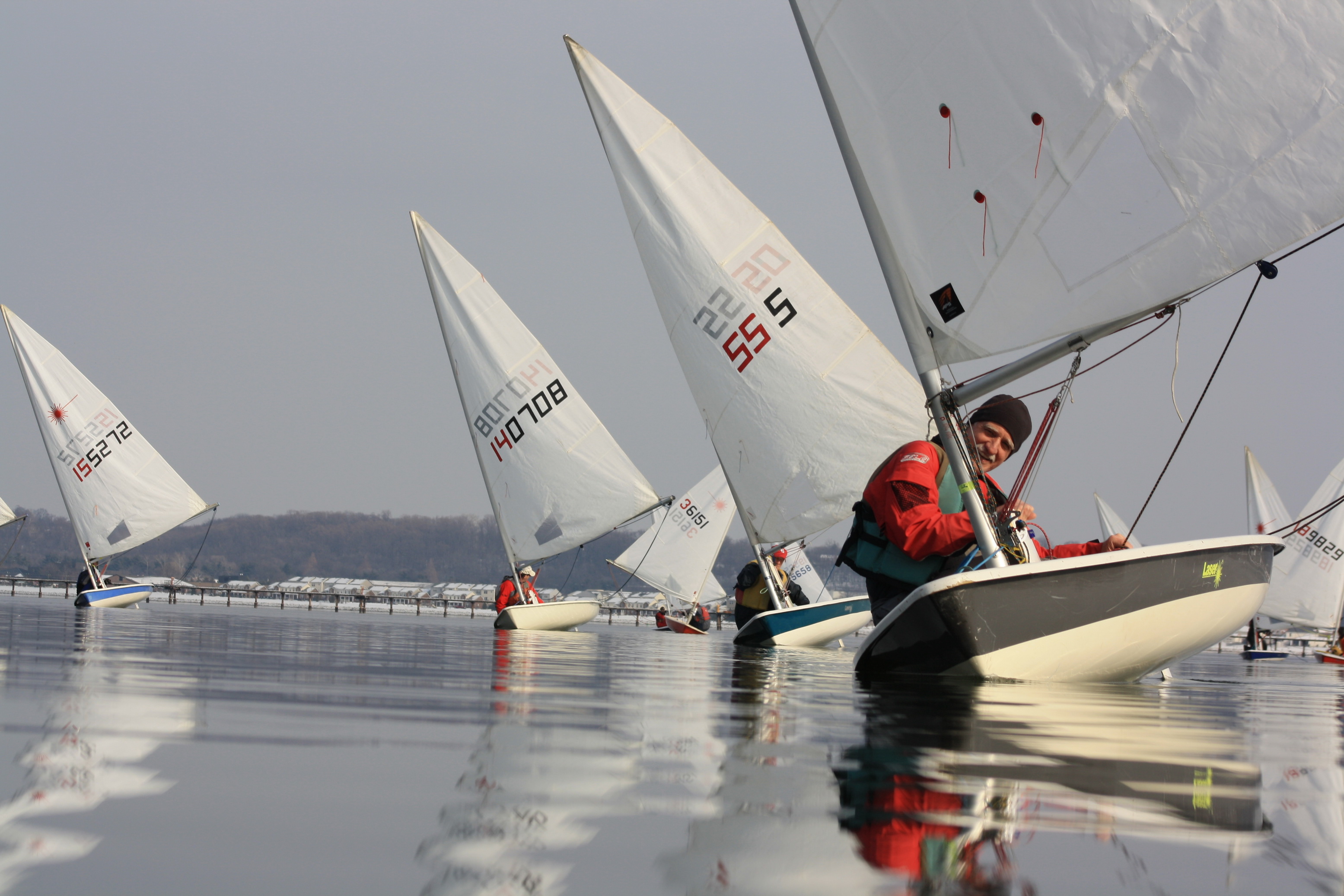
If you grow up sailing on a small creek, as I did, you are no stranger to shifty winds, land bends, dead spots and downdrafts. While the Potomac is a far cry wider and wilder than Beaver Dam Creek in Point Pleasant, N.J., it was no less fickle wind-wise on New Year’s Day for the Potomac River Sailing Association Hangover Regatta, which saw a very tight fleet of 30 boats, scrambling through an oscillating breeze that seemed to switch on and off at will.

All in all, conditions were, in my opinion at least, near ideal for a frostbite regatta (though many including me, were wishing the unseasonably warm weather of the week before had stuck around for a day longer) with a nice 8-knot breeze ushering the fleet out of the marina and past the runway of Reagan International Airport  and quickly building into fresher, sustained gusts.

As many of you may know, I usually sail on the Elizabeth River in Norfolk with the Hampton Roads Sailing posse.  Four of us, Charlie Brewer, Britt Drake, Grant Simmons and myself schlepped it up I-95 for the regatta and by the time I arrived at 10 a.m. Charlie and Britt had built a nice little firepit with some of the river driftwood down by the boat hoists and were keeping their hands warm by the crackling fire. The out-of-towners drew a bit of amusement, but at least it took the chill off.

And it was brisk: The weather station at Reagan International Airport recorded a mean temperature for the day of 37 degrees with a maximum in the partly sunny afternoon of 47 degrees. Winds were generally SSW at about 8 mph with a maximum recorded wind speed of 21 mph and a few gusts up to 24. (There were a fair number of upturned hulls during the day for those caught out by the blasts. I got caught trying to sail deep by the lee when one of those gusts caught me. My scramble up the deck was too late, but I didn’t get wet, so I am not counting it as an actual capsize even though I brought some souvenir Potomac River bottom mud home on the head of my sail.) Charlie said he got dipped twice, once going upwind when a gust came at him behind the sail. “normally you can just hang on and it will switch back and lift you up,” Charlie said. But not that time, apparently. I spent a lot of time looking ahead (upwind) and behind (downwind) to try to read the gusts from the angles and heal of other boats. It served me pretty well as I was able to prepare for a few major onslaughts of wind before they got to me.

Race Committee Chair Nabeel Alsalam set a perfect windward-leeward course with a leeward gate and a short-leg upwind finish. Races were run twice around the course and, given the conditions, lasted about 30 minutes each. A total of five races were run and the scoring included a throw-out. Starts were run in three minute sequences with a whistle countdown, so if you are like me and sail without a watch, you were not at any significant disadvantage. (We run with three minute starts down in Norfolk, too, and it seems to be a lot better for dinghy racing, even with bigger fleets. How hard is it to choose a spot on the line and set up in a Laser, after all. And less time to get cold. If the line length is about 30 seconds, two minutes is plenty of time to run a check and commit to a strategy, I think.)

Despite the very shifty gusts, the line was very square all day, with a slight committee boat bias. This was balanced out by a slightly favored left side of the course which seemed to pay off with a bit more pressure and for those boats that went deep enough into the corner, a huge lift to the windward mark along the western shore of the river.

And that seemed to be the challenge of the day: how to tap into the shifts and very localized pressure zones. Upwind, the pressure seemed to emerge from the right, but the better lifts seemed to favor the left. A key was not to get caught in the middle too early on the course.

In the first race, both Charlie and I joined the massive fight for a spot near the committee boat and got caught up in the air sponge of sails losing whatever advantage might have been gained by the line bias and losing options to tack out in the throng of boats. After seeing the left-side boats cash in, we both found ourselves switching plans, moving down to the center of the line below the scrum and able to blast out with a clean lane. This seemed to pay off in several races as the lift back to the mark seemed to be greater the deeper out you got.

Regatta winner Charlie Brewer had another idea which twice paid dividends for him (and burned him once, too.) He ducked the entire fleet on one start to go out far to the right to try to get to the pressure lines first. He was out nearly by his lonesome and it wasn’t looking good for awhile, until he came zooming into the top mark clear ahead of the fleet with only (I believe) Eric Peterson nearby. I have seen Charlie do this before in Norfolk and his thinking is, (correct me if I am wrong, Charlie) if you are in clear air and sailing fast rather than mixing it up in the crowd you are likely to do well. The shifty conditions certainly helped that strategy. If you were attentive to the breeze you could climb the ladder pretty fast. If not, there were a lot of snakes around.

Toward the end of the day, the river current began to sweep out along the eastern shore and played an interesting role at the bottom mark. Logic seemed to dictate that if you sailed to the left (going downwind) the outgoing tide would sweep you into the gates. But that led to a more direct downwind angle which actually turned out to be slower. (In my experience on the course) Those sailing deeper to the right, sailed hotter angles at the bottom and often got a little lift of speed near the gates that squirted them forward. It worked for me, anyway, once I cottoned on. The big key downwind, I found, was just to look aft for the pressure lines on the water and try to position in front of them well ahead of their arrival. Then, work the waves and gusts building speed ahead of the waves and soaking down once the pressure is full on.

Thanks again to Potomac River Sailing Association for hosting this event and inviting your friends from the south up to take part. It was a great time and the after-race brew and chew was a lot of fun. Hope to see you next year.

Robert Suhay

2016 Hangover Regatta

Regatta Photos (courtesy of Jim Lane)

President’s/Leukemia Cup 2011 – Day 1 results

It turned out to be a beautiful sailing day despite all the rain we had leading up to it. The river was remarkably clean. Only the occassional log showed up — I saw maybe 4 all day long. The current was strong but the NW breeze was enough for the sailors to sail against it. Downwind & down current the sailors flew. There were enough shifts to keep the sailors thinking about strategy. We did 4 W2 races. Below are the preliminary and interim results:

Albacore Day 1 results
Buccaneer Day 1 results
Catamaran Day 1 results
Flying Scot Day 1 results
Lightning Day 1 results


77th Annual President’s/Leukemia Cup Regatta

Hello PRSA members, just around the corner is our annual 77th
President’s/Leukemia Cup regatta Sept 10th and 11th. Information
including the schedule of events, NOR and pre-registration are on our
Web site located here:

http://www.potomacriversailing.org/PresidentsLeukemiaCups/

If you planning on racing, please take a moment to pre-register. If you
are interested in raising money for the L&LS indicate that on the
pre-registration form and they will contact you with additional details.

We have been working closely with L&LS to make this a more enjoyable
event for our members this year. For instance for the Saturday party
they are not going to start serving food until 4:15 and will be holding
back additional food for those that arrive late. There will also be
awards (half hull trophies) for 1st and 2nd place for Saturday.

If you have any questions Aaron Boesenecker is our liaison to L&LS,
Nabeel Alsalam is our upper course PRO and Jim Graham is our lower
course PRO. Or you can always ask me…

Also we are still looking for a Regatta Chairman (or woman) for this
event. The primary responsibility is to organize the party Sunday after
racing. Deciding what food to have, purchasing it, cooking it if
necessary. You can certainly plan to sail Sunday and do this job, I
have done it before, just requires some planning. If your interested
please let me know. Thanks

Scott

PRSA Spring Regatta 2011, Lower Course Results

If you missed Saturday you missed a great sailing day with a south breeze 10 mph and warm temps. We had sixteen boats with a few people who have not sailed in quite sometime. Steve Parsons sailed with us for the fist time in about a year and Cheryl Taylor has not sailed in over a year.

The day started out with a very solid breeze with very few wind shifts (unusual conditions for the river) but by the fourth race the river had found its wind shifty groove.

Cary Comer came out of the gate rounding all of the marks in the first race in first and finished fourth on the day. Len Guenther warmed up after the first three races and finished with a 3-1-3-4 and good enoguh for third place overall. Justin Pollack was very consistent and finish the day with a first in the last race and second in the overall standings. Erich Hesse loved the steady southerly and took the first place honors.

Thanks to Jim Graham for organizing the regatta. Big thanks to Rick Welch, Aaron Boesenecker (thanks for the pictures) and another Lightning crew member for great RC and crunching the numbers by hand afterwards. Thanks to Steve Parsons, Len, and Farley with helping flipping burgers and rolling hot dogs. I think a great time was had by all.

Erich Hesse (Laser Fleet Captain)

2011 PRSA Spring Regatta – Lasers

Pictures: Lasers on the Lower course

PRSA Spring Regatta 2011, Upper Course Results

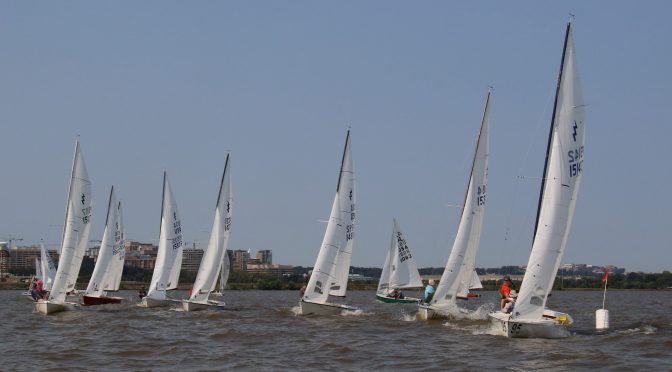
Another great day of sailing with south winds of 12 to 13. I wish the whole summer would be like that. Khin & Thant , Bill Buck, Dan Miller, and scorer/recorder Jen gave us 3 W2 races. Several more sailors came out to join the fun. Jim Graham gave us another nice picnic.

Results:
PRSA_spring11_Albacore
PRSA_spring11_Buccaneer
PRSA_spring11_Hobie
PRSA_spring11_Lightning

The Katherine Hearst award to the woman who beat the most boats in her class went to Kyra Tallon.
The Len Penso award to the sailor over 50 who beat the most boats in his/her class went to Nabeel Alsalam.

Pictures Upper course and Lower course

Spring Regatta, Day 1 Results for Upper Course

What a beautiful day to be sailing! Winds were around 10 from the S and SSW all day long. The very edge of a squall came through late and gave us just a few drops of rain and a little extra wind. Khin Thein gave us 4 races including a W2, two W3s, and another W2 or W1.

Come on out and join us on Day 2. It isn’t too late!

(The results for day 1 are attached.)
PRSA_spring11_Albacore_Overall
PRSA_spring11_Buccaneer_Overall
PRSA_spring11_Hobie_Overall
PRSA_spring11_Lightning_Overall